As I await the arrival of my order of the KEN PENDERS’ KNUCKLES OMNIBUS VOLUME ONE Variant and Non-Variant editions, I received word from my printer than the duty tax, or more commonly referred to as tariffs, was not going to be 7.5% of the cost of my order. Had it been, I would not be initiating this promotional offer.
Instead, I was told the tariff I would be paying amounted to 20% of the cost of my order, which is significantly more than I expected. If you know anything about the economics of the comics industry, a 20% tariff on top of the cost of books can make matters exceedingly difficult if not impossible for most publishers to go forward with a project.
When figuring out the viability of the KNUCKLES OMNIBUS project, my big concern was making certain all costs would be covered. Sure, I’d like to get paid and see my fellow creators receive their royalties, but the bills had to be paid first. Instead of going deep into debt as a result of the tariffs, I came to the following solution.
Simply ORDER A COPY of the NON-VARIANT EDITION. Do NOT select any signature option that requires payment. Make your purchase. The FIRST 30 people to do this will receive an emailed copy of their receipt along with confirmation they are one of the 30, which entitled them to have their book SIGNED FREE OF CHARGE – whether PERSONALIZED or JUST A SIGNATURE. As an added bonus, a HAND-DRAWN SKETCH OF KNUCKLES as seen above will be acknowledged in the emailed receipt being included as part of the order that’s also signed as requested.
The books will be arriving sometime late June, and will require a day or two for organizing and prepping for shipping. ALL orders will be processed and shipped on a first come-first serve basis.
This is a system that has served me well with regards to THE LARA-SU CHRONICLES: BEGINNINGS hardcover collection. To date, if a problem has arisen with any order, I’ve always been able to resolve any issue quickly and to everyone’s satisfaction.
I can’t stress enough how every sale made on my online store is important at this time to the future efforts of Floating Island Productions. The information I’m receiving from abroad indicates things are only going to get harder and more expensive in the coming months. Since I believe everyone should receive something for their hard-earned money, this offer is what I came up with. Your support at this time is needed and very much appreciated. Thank you and take care.
Recently, I had taken a break from everything in order to fly out to the east coast to spend some quality time with my son Stephen and my grandchildren Julian, Jovie and Jemma. By quality time, I mean taking care of them from morning to night, providing them their meals, engaging with them in various activities, reading to them before bed, doing their laundry and so on. In many ways, the routine was similar to what I experienced being a parent to Stephen at the age his children are now at, but in other respects, it was different, as I never had a sister or a daughter.
And both experiences were and are vastly different from how I was raised by my parents.
For years I heard from readers what a bad parent Knuckles’ father Locke was, and as I reviewed the stories I was collecting for inclusion to the KEN PENDERS’ KNUCKLES OMNIBUS VOLUME ONE, it became more than apparent – to me, at least – that Locke was never a bad parent. If anything, he was misunderstood.
It also made me aware how much of my own father I used as the basis for the character, way more than the superficial level I had believed.
I didn’t think much when writing the stories to use actual interactions between my father and I. After all, many were of a personal nature under circumstances that didn’t track with the story being told. And yet, Locke’s actions in many cases mirrored my own father’s. Even the moment when readers witnessed Locke apparently abandoning his own son. Taken on its own, I suppose some would see it cruel and irresponsible. But that action was always taken out of context. It just never occurred to me how much of a generational divide there was between what I experienced growing up and what readers my own kids’ ages did.
Neither of my sons or my grandchildren have grown up in an era as I did where getting drafted into the US Military to go fight a war overseas was something one confronted on a daily basis once one hit the teenage years. It was because of that reality that my father made clear to me that when I turned 18 years old, I had better figure out what I was going to do as living at home was not an option.
I did not know it at the time, but my father in actuality was preparing me for the curve balls life would be throwing my way. He never talked about his teenage years or the time he spent in the military. Nor did he ever discuss the medals he kept tucked away in his dresser drawer.
It wasn’t until years later that I was told by my Great-Aunt Frances that my father had gotten into trouble with the law, something to do with a motorcycle. Whatever happened, the next morning afterwards my father woke up out of bed to find Frances cooking breakfast for a couple of Buffalo’s finest as they waited on my father to come staggering into the kitchen. Shortly after breakfast and my father getting dressed, he was in police custody taken to be arraigned in court. Once there, he was given the choice: jail or accompany the US Marine recruiter.
It was only recently I learned after discovering his discharge papers my father had been enlisted in the US Marines barely a week after turning 17 years old, sent to Basic Training at Camp Lejeune and shipped out to Korea to fight in an undeclared war.
It was because of that experience as well as the unhappy childhood he lived through that he hoped he could provide better for his sons. Whereas he could more easily relate to my brothers, I was a tougher nut for him to crack. He didn’t know how to guide me or provide the proper advice because nothing I was interested in was anything he could relate to.
He couldn’t advise me on the career path I had set my focus on, as he would be the first to admit he didn’t know anything about being a commercial artist, let alone being able to discuss the differences between fine art and commercial artist.
He couldn’t advise me on how to apply for college or what courses to take or which college to go to, as he had never had that experience. It wasn’t until he was in the military that he passed his GED test.
But I had just graduated high school at the age of 16, and my 17th birthday was only three months away. If I didn’t go to college, I would have to find some form of employment to support myself. Back then, no one encouraged kids to live with their parents after graduating from high school.
What he could do was set an example, using the Sink-or-Swim method as one means of motivating one to achieve a goal. The best example I can provide was how I learned how to drive a car.
I had just turned 16 the day I went to the downtown Buffalo DMV to take the written test for my driver’s license. Having aced that, the next day I took the 3-hr driving class led by an instructor along with several other individuals. When I emerged from the classroom, I spotted the Chevy Impala my father drove at the time with my father seated behind the steering wheel.
I don’t know what I imagined at the time, but I figured he was going to start having me drive on the streets closer to home. Instead, he slid across the front bench motioning me to get behind the wheel. He held a stick more than a foot long about an inch, inch and a half in diameter, and told me I was going to drive the car home, adding that for each mistake I made he was going to hit me on the knee.
While this may sound barbaric to modern sensibilities, keep in mind that young men my age at the time were generally disciplined by their fathers with The Belt. There wasn’t a family who lived on our street that didn’t receive at least one visit from the authorities whenever an incident of domestic violence got out of hand. After all, it was a blue collar working class white suburban neighborhood I grew up in.
So my father told me put the car in motion, reminding me to use my hand signals as well as the car’s directional signal, and directed me to drive towards the downtown section of the city. He proceeded to put me through the motions, so that by the time we returned home, I had executed a 3-point turn, learned to parallel park and learned the right-of-way when making a left turn on busy city streets for my first time out.
It didn’t take long after that for me to acquire my driver’s license, enjoying both the freedom and responsibility that came with it. (Within a year or so later, I would learn to drive a stick-shift car on the streets of Boston in a similar baptism by fire.)
Since my parents couldn’t afford to send me to college, I made the decision to let the military pick up the tab by enlisting. Back then, the Vietnam war had ended, the draft discontinued, with the US Military switching to go with an all-volunteer force. In order to meet recruiting goals, the military offered a very enticing incentive: they would pay for one’s college education.
Initially, I was looking to enlist with the US Army, as they were offering a $2500 signing bonus (approximately $15,000.00 in today’s dollars). When I brought home the papers for my parents to sign, my father made clear the Army was not an option. The only military branch he and my mother would agree to sign the papers to was the US Air Force.
I may not have gotten the signing bonus, but the Air Force did pay for the college courses I did sign up for. It also provided a crash course on dealing with the responsibilities and consequences resulting from the choices one made. When my initial 4-year enlistment was up, I was given the choice of re-enlisting or getting a discharge and going off on my own.
While my mother lobbied for me to re-enlist, my father surprised me by saying what I did was my own choice, but if I failed, I could always return home to start over again until I was ready to venture forth into the world.
By providing that safety net, he enabled me to make my own way into the world with whatever choice I made.
But it wasn’t until he was on his death bed and we had our last talks that I learned how much attention he actually paid to what I did, even when I thought I wasn’t on his radar. I may have thought I was on my own, but I was never really alone as far as he was concerned.
He kept track but kept his distance, and it was this reality that I used as the basis for the character Locke and his relationship with his son Knuckles.
When assembling the stories featured in the KEN PENDERS’ KNUCKLES OMNIBUS VOLUME ONE, I did so in the chronological order they were meant to be read. Once that occurred, it became obvious that Locke’s actions tracked with my father’s. Locke and Knuckles were always meant to go their own paths. Knuckles may have been a bit young to be off on his own, but that was how the world I knew worked back then.
What’s really struck home with me is for the longest time I thought the story FATHER’S DAY, in which Knuckles experiences the death of his father, was more a one-off of me coming to terms with the loss of my own father.
In reality, it was never a one-off. I may have come to terms with the loss back then, but it’s only now I’m coming to terms with the reality I actually lived, and how I expressed that reality in these stories. My relationship with my father was never easy, but in the end he provided the only validation I ever needed from him.
And I’ve been at peace ever since.
It’s also why anyone else who writes a story using the character Locke will always have a difficult time of getting my approval. Because they didn’t experience the character the way I have. And they never will.
It’s also why the character Lara-Su’s relationship with her father is vastly different. Times have changed and so has the world they live in. Knuckles recognizes he couldn’t grow into the being he is without the experiences he had with his father, and why that experience will always be special.
When one is a child, the world is binary – black & white, good & evil. But when one is an adult, the older one gets, the more shades of grey come into view. I have the perspective now I didn’t have growing up, because I had yet to confront the choices and nuances of those choices one encounters along the way.
I see now that however imperfect he was, he still tried to do the best he could for his family, including me. I just wish I could’ve acknowledged that more than I did before his passing.
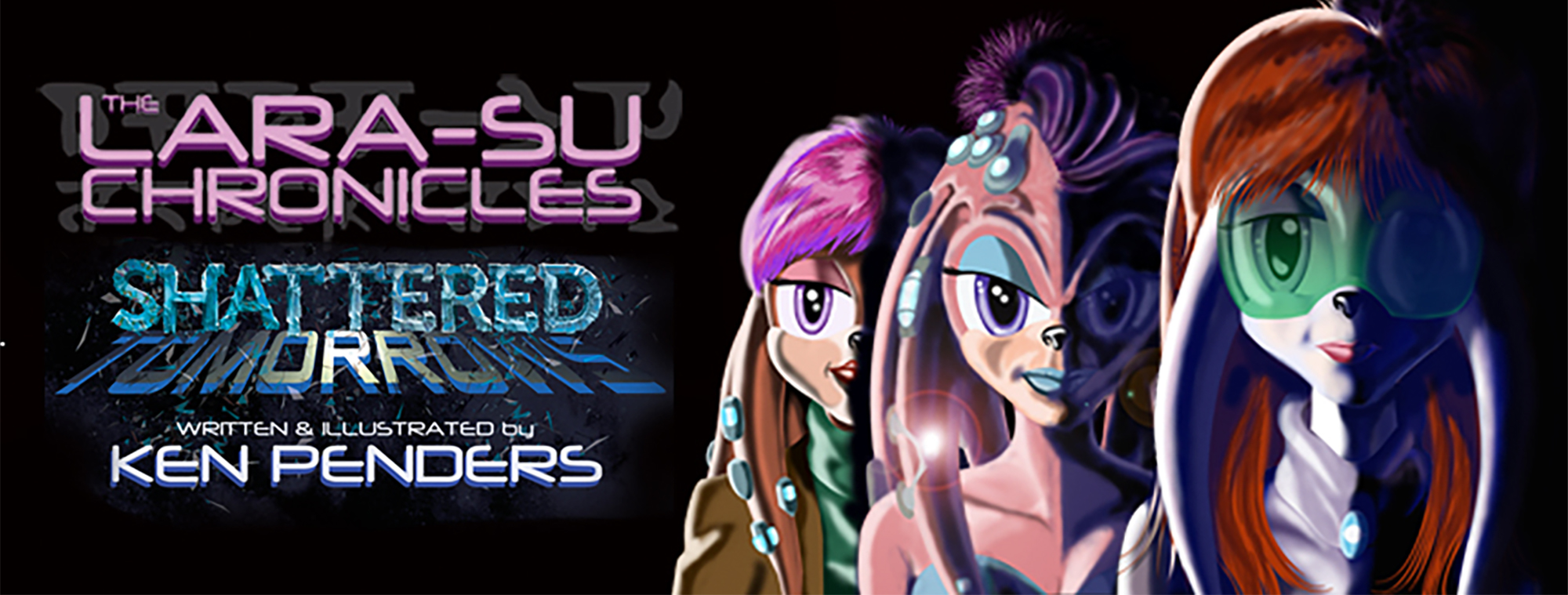
I find it hard to believe it’s been almost a year since copies of THE LARA-SU CHRONICLES: BEGINNINGS were sent out to those who pre-ordered a copy in the months prior to that, but once I get past the release of KEN PENDERS’ KNUCKLES OMNIBUS VOLUME ONE (more on this later) and wrap work on THE LARA-SU APP, it’s full speed ahead on THE LARA-SU CHRONICLES: SHATTERED TOMORROWS with the intent to see the print edition released during the Christmas 2026 season.
I haven’t talked much about the story and what people can look forward to, as I haven’t wanted to spoil the many surprises in store. That said, I think it fair to give people some idea that what came before doesn’t begin to prepare readers for what they can expect, as it goes way beyond anything depicted in previous stories.
As an example, here are two pages from the script of SHATTERED TOMORROWS.
As I establish in BEGINNINGS, Mobius is destroyed, and it’s now a battle for survival among the colonies that escaped the cataclysm. The life that everyone knew wherever they were has changed forever, and everyone is dealing with that reality in different ways. Some cling to hope while others take a darker path. For every action, there is a reaction, and no return to the status quo.
I started writing the script for SHATTERED TOMORROWS more than 13 years ago, changing plot points along the way, adding details and characters as the story began to take shape. Even I was surprised by some of the secrets unveiled that were only hinted at in previous stories as I wrote the narrative. Relationships and events I hadn’t realized began to fall into place.
The funny thing is the more I tried taking the story in a direction that moved it far from what had come before, the more it embraced what had come before and built on that. After a while, I quit fighting it and wrote where the story was always intended to go.
As I work on SHATTERED TOMORROWS, sections will be initially released in THE LARA-SU APP. Once the initial story is complete, it will be collected in a hardcover format graphic novel.
Whichever way one enjoys the story as it unfolds, I look forward to your questions and comments as we embark on the journey of THE LARA-SU CHRONICLES. Thanks for sharing the adventure.