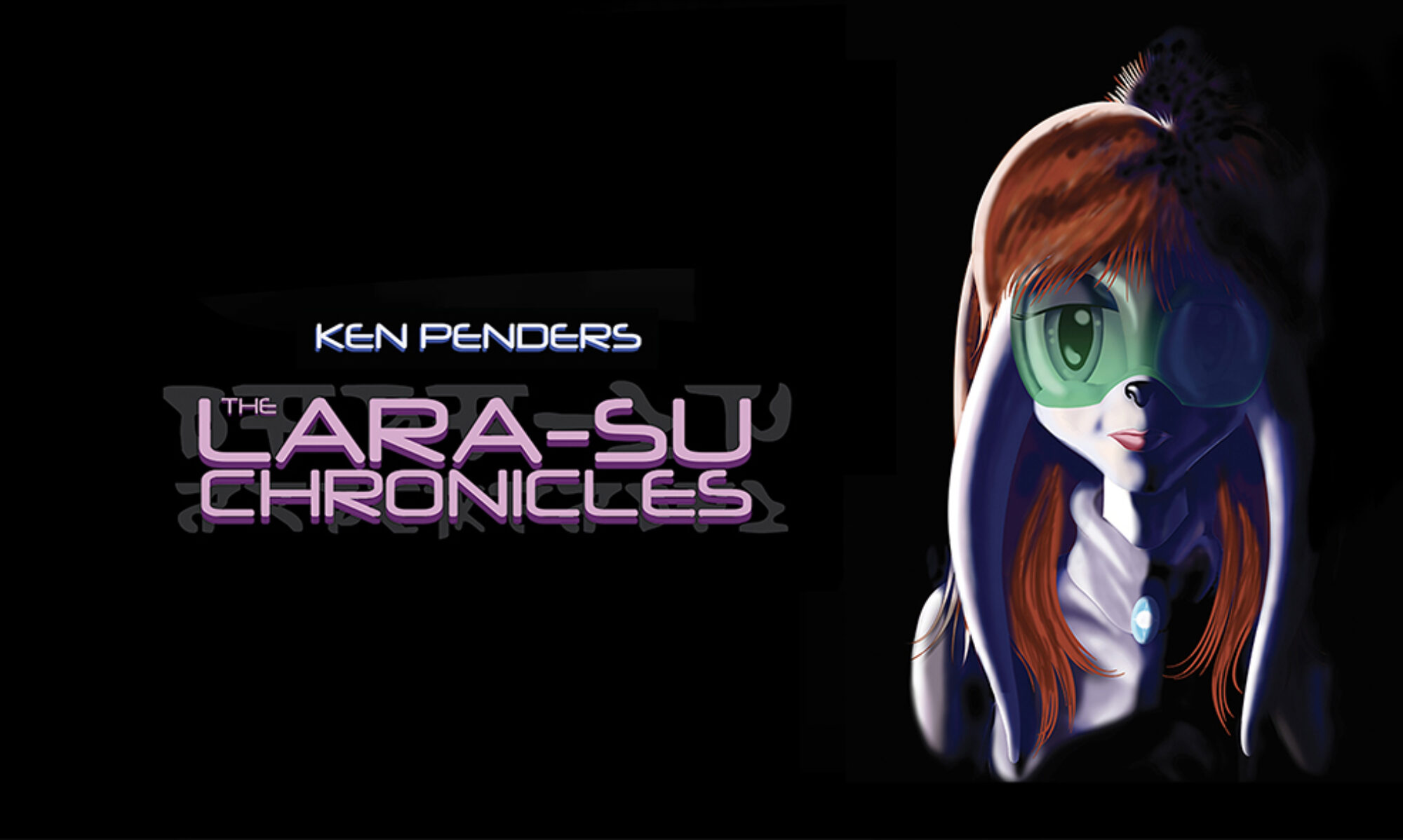
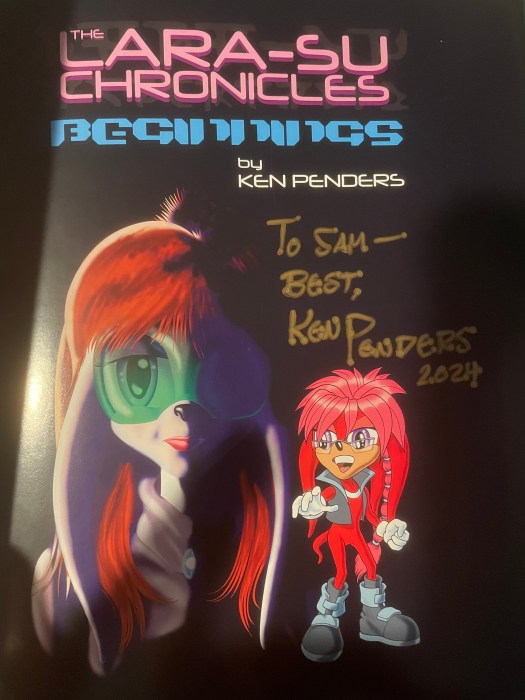
As I await the arrival of my order of the KEN PENDERS’ KNUCKLES OMNIBUS VOLUME ONE Variant and Non-Variant editions, I received word from my printer than the duty tax, or more commonly referred to as tariffs, was not going to be 7.5% of the cost of my order. Had it been, I would not be initiating this promotional offer.
Instead, I was told the tariff I would be paying amounted to 20% of the cost of my order, which is significantly more than I expected. If you know anything about the economics of the comics industry, a 20% tariff on top of the cost of books can make matters exceedingly difficult if not impossible for most publishers to go forward with a project.
When figuring out the viability of the KNUCKLES OMNIBUS project, my big concern was making certain all costs would be covered. Sure, I’d like to get paid and see my fellow creators receive their royalties, but the bills had to be paid first. Instead of going deep into debt as a result of the tariffs, I came to the following solution.
Simply ORDER A COPY of the NON-VARIANT EDITION. Do NOT select any signature option that requires payment. Make your purchase. The FIRST 30 people to do this will receive an emailed copy of their receipt along with confirmation they are one of the 30, which entitled them to have their book SIGNED FREE OF CHARGE – whether PERSONALIZED or JUST A SIGNATURE. As an added bonus, a HAND-DRAWN SKETCH OF KNUCKLES as seen above will be acknowledged in the emailed receipt being included as part of the order that’s also signed as requested.
The books will be arriving sometime late June, and will require a day or two for organizing and prepping for shipping. ALL orders will be processed and shipped on a first come-first serve basis.
This is a system that has served me well with regards to THE LARA-SU CHRONICLES: BEGINNINGS hardcover collection. To date, if a problem has arisen with any order, I’ve always been able to resolve any issue quickly and to everyone’s satisfaction.
I can’t stress enough how every sale made on my online store is important at this time to the future efforts of Floating Island Productions. The information I’m receiving from abroad indicates things are only going to get harder and more expensive in the coming months. Since I believe everyone should receive something for their hard-earned money, this offer is what I came up with. Your support at this time is needed and very much appreciated. Thank you and take care.
Recently, I had taken a break from everything in order to fly out to the east coast to spend some quality time with my son Stephen and my grandchildren Julian, Jovie and Jemma. By quality time, I mean taking care of them from morning to night, providing them their meals, engaging with them in various activities, reading to them before bed, doing their laundry and so on. In many ways, the routine was similar to what I experienced being a parent to Stephen at the age his children are now at, but in other respects, it was different, as I never had a sister or a daughter.
And both experiences were and are vastly different from how I was raised by my parents.
For years I heard from readers what a bad parent Knuckles’ father Locke was, and as I reviewed the stories I was collecting for inclusion to the KEN PENDERS’ KNUCKLES OMNIBUS VOLUME ONE, it became more than apparent – to me, at least – that Locke was never a bad parent. If anything, he was misunderstood.
It also made me aware how much of my own father I used as the basis for the character, way more than the superficial level I had believed.
I didn’t think much when writing the stories to use actual interactions between my father and I. After all, many were of a personal nature under circumstances that didn’t track with the story being told. And yet, Locke’s actions in many cases mirrored my own father’s. Even the moment when readers witnessed Locke apparently abandoning his own son. Taken on its own, I suppose some would see it cruel and irresponsible. But that action was always taken out of context. It just never occurred to me how much of a generational divide there was between what I experienced growing up and what readers my own kids’ ages did.
Neither of my sons or my grandchildren have grown up in an era as I did where getting drafted into the US Military to go fight a war overseas was something one confronted on a daily basis once one hit the teenage years. It was because of that reality that my father made clear to me that when I turned 18 years old, I had better figure out what I was going to do as living at home was not an option.
I did not know it at the time, but my father in actuality was preparing me for the curve balls life would be throwing my way. He never talked about his teenage years or the time he spent in the military. Nor did he ever discuss the medals he kept tucked away in his dresser drawer.
It wasn’t until years later that I was told by my Great-Aunt Frances that my father had gotten into trouble with the law, something to do with a motorcycle. Whatever happened, the next morning afterwards my father woke up out of bed to find Frances cooking breakfast for a couple of Buffalo’s finest as they waited on my father to come staggering into the kitchen. Shortly after breakfast and my father getting dressed, he was in police custody taken to be arraigned in court. Once there, he was given the choice: jail or accompany the US Marine recruiter.
It was only recently I learned after discovering his discharge papers my father had been enlisted in the US Marines barely a week after turning 17 years old, sent to Basic Training at Camp Lejeune and shipped out to Korea to fight in an undeclared war.
It was because of that experience as well as the unhappy childhood he lived through that he hoped he could provide better for his sons. Whereas he could more easily relate to my brothers, I was a tougher nut for him to crack. He didn’t know how to guide me or provide the proper advice because nothing I was interested in was anything he could relate to.
He couldn’t advise me on the career path I had set my focus on, as he would be the first to admit he didn’t know anything about being a commercial artist, let alone being able to discuss the differences between fine art and commercial artist.
He couldn’t advise me on how to apply for college or what courses to take or which college to go to, as he had never had that experience. It wasn’t until he was in the military that he passed his GED test.
But I had just graduated high school at the age of 16, and my 17th birthday was only three months away. If I didn’t go to college, I would have to find some form of employment to support myself. Back then, no one encouraged kids to live with their parents after graduating from high school.
What he could do was set an example, using the Sink-or-Swim method as one means of motivating one to achieve a goal. The best example I can provide was how I learned how to drive a car.
I had just turned 16 the day I went to the downtown Buffalo DMV to take the written test for my driver’s license. Having aced that, the next day I took the 3-hr driving class led by an instructor along with several other individuals. When I emerged from the classroom, I spotted the Chevy Impala my father drove at the time with my father seated behind the steering wheel.
I don’t know what I imagined at the time, but I figured he was going to start having me drive on the streets closer to home. Instead, he slid across the front bench motioning me to get behind the wheel. He held a stick more than a foot long about an inch, inch and a half in diameter, and told me I was going to drive the car home, adding that for each mistake I made he was going to hit me on the knee.
While this may sound barbaric to modern sensibilities, keep in mind that young men my age at the time were generally disciplined by their fathers with The Belt. There wasn’t a family who lived on our street that didn’t receive at least one visit from the authorities whenever an incident of domestic violence got out of hand. After all, it was a blue collar working class white suburban neighborhood I grew up in.
So my father told me put the car in motion, reminding me to use my hand signals as well as the car’s directional signal, and directed me to drive towards the downtown section of the city. He proceeded to put me through the motions, so that by the time we returned home, I had executed a 3-point turn, learned to parallel park and learned the right-of-way when making a left turn on busy city streets for my first time out.
It didn’t take long after that for me to acquire my driver’s license, enjoying both the freedom and responsibility that came with it. (Within a year or so later, I would learn to drive a stick-shift car on the streets of Boston in a similar baptism by fire.)
Since my parents couldn’t afford to send me to college, I made the decision to let the military pick up the tab by enlisting. Back then, the Vietnam war had ended, the draft discontinued, with the US Military switching to go with an all-volunteer force. In order to meet recruiting goals, the military offered a very enticing incentive: they would pay for one’s college education.
Initially, I was looking to enlist with the US Army, as they were offering a $2500 signing bonus (approximately $15,000.00 in today’s dollars). When I brought home the papers for my parents to sign, my father made clear the Army was not an option. The only military branch he and my mother would agree to sign the papers to was the US Air Force.
I may not have gotten the signing bonus, but the Air Force did pay for the college courses I did sign up for. It also provided a crash course on dealing with the responsibilities and consequences resulting from the choices one made. When my initial 4-year enlistment was up, I was given the choice of re-enlisting or getting a discharge and going off on my own.
While my mother lobbied for me to re-enlist, my father surprised me by saying what I did was my own choice, but if I failed, I could always return home to start over again until I was ready to venture forth into the world.
By providing that safety net, he enabled me to make my own way into the world with whatever choice I made.
But it wasn’t until he was on his death bed and we had our last talks that I learned how much attention he actually paid to what I did, even when I thought I wasn’t on his radar. I may have thought I was on my own, but I was never really alone as far as he was concerned.
He kept track but kept his distance, and it was this reality that I used as the basis for the character Locke and his relationship with his son Knuckles.
When assembling the stories featured in the KEN PENDERS’ KNUCKLES OMNIBUS VOLUME ONE, I did so in the chronological order they were meant to be read. Once that occurred, it became obvious that Locke’s actions tracked with my father’s. Locke and Knuckles were always meant to go their own paths. Knuckles may have been a bit young to be off on his own, but that was how the world I knew worked back then.
What’s really struck home with me is for the longest time I thought the story FATHER’S DAY, in which Knuckles experiences the death of his father, was more a one-off of me coming to terms with the loss of my own father.
In reality, it was never a one-off. I may have come to terms with the loss back then, but it’s only now I’m coming to terms with the reality I actually lived, and how I expressed that reality in these stories. My relationship with my father was never easy, but in the end he provided the only validation I ever needed from him.
And I’ve been at peace ever since.
It’s also why anyone else who writes a story using the character Locke will always have a difficult time of getting my approval. Because they didn’t experience the character the way I have. And they never will.
It’s also why the character Lara-Su’s relationship with her father is vastly different. Times have changed and so has the world they live in. Knuckles recognizes he couldn’t grow into the being he is without the experiences he had with his father, and why that experience will always be special.
When one is a child, the world is binary – black & white, good & evil. But when one is an adult, the older one gets, the more shades of grey come into view. I have the perspective now I didn’t have growing up, because I had yet to confront the choices and nuances of those choices one encounters along the way.
I see now that however imperfect he was, he still tried to do the best he could for his family, including me. I just wish I could’ve acknowledged that more than I did before his passing.
I find it hard to believe it’s been almost a year since copies of THE LARA-SU CHRONICLES: BEGINNINGS were sent out to those who pre-ordered a copy in the months prior to that, but once I get past the release of KEN PENDERS’ KNUCKLES OMNIBUS VOLUME ONE (more on this later) and wrap work on THE LARA-SU APP, it’s full speed ahead on THE LARA-SU CHRONICLES: SHATTERED TOMORROWS with the intent to see the print edition released during the Christmas 2026 season.
I haven’t talked much about the story and what people can look forward to, as I haven’t wanted to spoil the many surprises in store. That said, I think it fair to give people some idea that what came before doesn’t begin to prepare readers for what they can expect, as it goes way beyond anything depicted in previous stories.
As an example, here are two pages from the script of SHATTERED TOMORROWS.
As I establish in BEGINNINGS, Mobius is destroyed, and it’s now a battle for survival among the colonies that escaped the cataclysm. The life that everyone knew wherever they were has changed forever, and everyone is dealing with that reality in different ways. Some cling to hope while others take a darker path. For every action, there is a reaction, and no return to the status quo.
I started writing the script for SHATTERED TOMORROWS more than 13 years ago, changing plot points along the way, adding details and characters as the story began to take shape. Even I was surprised by some of the secrets unveiled that were only hinted at in previous stories as I wrote the narrative. Relationships and events I hadn’t realized began to fall into place.
The funny thing is the more I tried taking the story in a direction that moved it far from what had come before, the more it embraced what had come before and built on that. After a while, I quit fighting it and wrote where the story was always intended to go.
As I work on SHATTERED TOMORROWS, sections will be initially released in THE LARA-SU APP. Once the initial story is complete, it will be collected in a hardcover format graphic novel.
Whichever way one enjoys the story as it unfolds, I look forward to your questions and comments as we embark on the journey of THE LARA-SU CHRONICLES. Thanks for sharing the adventure.
What he doesn’t state or talk about is the fact Marvel and DC represent the pinnacle of page rates for creators, ignoring the fact most creators make less – far less in most cases – working for other publishers.
I speak from experience with a 40-year perspective of having worked in the business that pay for producing script and art in the comic book industry really hasn’t changed much during that time. If anything, it’s gotten worse.
When I received my 1st professional comic book assignment, it was as a penciler for the DC Comics mini-series WHO’S WHO IN STAR TREK issue 1. It was for 6 pages of penciled illustrations and I was paid $75 a page. By the time I illustrated the pencil art for CAPTAIN ATOM issue 41, my page rate for pencils was $150. By the mid-1990s, I was earning $200 per page penciling an issue for Malibu Comics’ STAR TREK DEEP SPACE NINE series. I produced 3 issues worth of material.
When I was being considered for the gig of full-time penciler on a series DC Comics was considering licensing from LucasArts, I was paid $250 a page for 3 pages of penciled & inked character sketches along with $150 per page for 3 pages of sample storytelling displaying the characters. I was told if the series was a go, I would be offered a contract committing me to 24 issues – the length of the license – along with the cover assignment for the book starting with issue 13.
Had the assignment moved forward, I most certainly would not have had time to even submit sample pitches to Archie Comics for their SONIC THE HEDGEHOG series. But due to various factors beyond my or even DC Comics’ control, the project collapsed.
During this time, I landed my 1st writing assignment for DC Comics. I don’t remember what it paid, but I know it was more than $50 for a page of script. When I submitted my 1st sample story pitches to Archie Comics for the SONIC series, it was all on spec with no guarantee of acceptance or payment.
My partner Mike Kanterovich and I won approval to develop 2 of the 3 pitches submitted into scripts, which we were then told we had to submit in page-panel format. That meant submitting a rough layout of each page showing the placement of the characters and word balloons. As Mike didn’t draw, I created the final look of our scripts. We were paid $40 per page of script which we split down the middle, but I was never paid for my layouts, which whatever penciler was assigned would use as their template when drawing the pages.
It was within a year or two after submitting our first scripts that Archie increased the page rate for scripts to $45. When I penciled a story I wrote, I received $85 per page. For inks, it was $75 a page. Lettering was $25 a page with coloring $20 a page back then. The difference between then and now with regards to coloring and lettering is that both are now generally done on a computer whereas both back then were done by hand. Coloring was generally applying markers or colored dyes to xerox copies then assigning an alpha-numeric code to specify which color was being depicted.
I lasted so long on the SONIC series despite being pulled off the book at least twice for irritating the publishers with my stand of supporting Dan DeCarlo publicly while he sued Archie over JOSIE AND THE PUSSYCATS as well as SABRINA THE TEENAGE WITCH, was due to my track record regarding sales of the SONIC book as well as Archie’s practice of sticking with talent who adhered to their mandates, especially when it came to meeting deadlines. Slackers were not tolerated.
What Rich also didn’t mention is that a creator’s longevity on any given book can never be taken for granted, as an editor who’s taken off a book and replaced with another editor generally means the writer and artists on the book are generally replaced as well.
I kept the wheels running on the SONIC and KNUCKLES series, lasting through 4 different editor changes, until it got to the point where I was making much more doing freelance for ad agencies as well as storyboards for animation and independent film projects.
Back in 2006, I was making $2000 a week at Film Roman producing storyboards for the FOX animated series KING OF THE HILL, which made the decision to leave Archie a no-brainer. (In all honesty, another reason I stayed so long is that SONIC was always my son’s favorite book, but by the time he was about to start college, he made it easier for me to work elsewhere,)
Within another few years, once I was well into my legal battle with Archie, I was told a number of stories of what people were earning, some of which made it into the affidavits in support of my case.
For example, Archie paid less for talent on their core titles than they did on the SEGA-licensed books. Inkers received $55 to ink an Archie page, whereas they would receive $75 a page on SONIC. Part of that was due to inker Jon D’Agostino’s complaining how much extra work SONIC required as opposed to the Archie assignments. Jon had been working for the company for so long and the company was reluctant to deal with any newcomers at the time.
While both Dan DeCarlo and Stan Goldberg received the highest page rates at the time from the company – $130 per page – when sales took a down turn, Archie didn’t hesitate to cut both men’s page rates by $20 per page, despite their long association with the company.
Rich also didn’t talk about how artists are exploited when it comes to reprints or other reuse of the artists’ work. Neither Archie or IDW has ever paid royalties for reprints, nor has any company releasing reprint collections of various series such DOCTOR SOLAR or other titles originally published under the Gold Key banner or any other company.
Go talk to artists who worked on various STAR TREK titles prior to IDW obtaining the license. Arne Starr, Gordon Purcell, myself and others all signed work-for-hire agreements that stipulated in exchange for our transfer of rights, we’d be paid for any reprinting of out work. When approached about paying royalties for work originally contracted for by DC Comics, IDW would tell freelancers to talk to Paramount or DC. When freelancers contacted Paramount, the licensing department would tell freelancers to talk to DC. When talking to DC, their representative would say DC no longer publishes the book, hasn’t had the license in a long time and suggests the freelancer talk to Paramount.
And STAR TREK is not the only licensed title freelancers are getting screwed out of what’s due them.
IDW has a history of reprinting a lot of work in which they never paid royalties to any of the freelancers whose work was used, even when the artists’ work was the main focus of the book. Stan Goldberg bitterly complained how IDW released a book titled THE BEST OF STAN GOLDBERG, yet he didn’t receive a dime from the sales nor did the company send him any complimentary copies of the published book as even a minimum form of compensation.
I myself was never contacted when Marvel reprinted a story I inked that was featured in the KULL OMNIBUS, nor was I contacted by Eaglemoss regarding the reprinting of my Trek work. It was only when one of the editors reached out to me regarding my unpublished Trek projects intended for DC and Marvel that I was able to least obtain a set of the books that featured my work. IDW never saw fit to contact me regarding the work I did for the TSR licensed books that DC Comics originally published that they were now collecting in trade paperback format. Nor has DC Comics reached out in any way as a result of my work being included in their WHO’S WHO IN DC COMICS OMNIBUS.
And I’m far from the only one receiving such treatment.
Rich also goes on to talk about how artists can make money on commissions or selling their artwork. And indeed they can. But not every page is a gem, nor is coherent storytelling a given, as more artists design their pages to feature the characters in the most active poses sellable to their audience. If a penciler’s work is sharp and clear with varying line weights, what do they need an inker for? If a penciler sends in only the scans of his pages, he or she gets to keep the all the actual art as all the inker is left with is digital reproductions.
One of the aspects that influenced me way back when on getting into comics wasn’t just the fun of writing and drawing stories, but the practicality of actually earning a living doing so. Take a look at pictures of people who worked for Marvel back in the late 1960’s. They wore jackets, dress shirts and ties, looking like they worked alongside Don Draper in MAD MEN. Many had families, owned homes and cars, enjoyed a night out. It was a steady gig for most, or so it seemed.
Before the Image guys left Marvel to form their own company, a number of freelancers were paid royalties that enabled them to put a substantial down payment on a home. I don’t hear of anyone able to do that these days unless the money comes in the form of payments from film or television projects.
One question that keeps getting asked these days is why would established Hollywood talent even bother slumming it for the low pay in comics? The answer is lies in comics being a cheap form of research & development, enabling an established talent to sell his or her own property as a film or TV project based on the property’s track record as a series or graphic novel. The secondary reason is that a creator in comics receives generally more recognition for their contribution to the work than they would in most cases from a TV or film project. With film, the directors generally get the lion’s share of the credit. Once more than one name is listed for the screenwriting credits, it’s hard to figure out who did what, thus the recognition doesn’t follow. Likewise, in television, it’s the series creator that receives the most credit. Other writers have worked on episodes throughout the run of MAD MEN, but it’s Matthew Weiner who gets the credit, as do other creators similar receive from the series they spearheaded.
With comics, especially creator-owned books, there’s no debating who did what. Even if a writer didn’t create the book, comic book writers are generally afforded more credit than most, thus you have Chris Claremont’s X-MEN, or Alan Moore’s SWAMP THING. Or even me with SONIC. While I have always maintained I never created Sonic and/or Knuckles, that doesn’t stop people from thinking I have.
Frankly, for the amount of work it takes to produce a monthly comic book, $3200 a month or $38,400 annually is not a living wage, especially in most places in the United States, let alone New York and Los Angeles. After taxes and rent (forget about a mortgage), there’s groceries (at a minimum people are spending $100 a week to eat and we’re not talking filet mignon either), transportation (owning or leasing a car requires fuel and insurance), utilities and so on. Before one can even subscribe to a streaming service, one has to pay for monthly internet service, which can cost $50 to $100 or more a month. We haven’t even talked entertainment or more serious matters like settling down and having kids.
One can earn a better living working at McDonald’s or Staples. Costco is now paying $30 an hour minimum wage to its workers. At the company my next door neighbor owns, not one of his workers makes less than $20 an hour, and they all have benefits including health care and paid tuition assistance.
To really put the $38,400 in true perspective, writer George Gladir was earning that much annually writing scripts for various Archie comics back in 1996. He had been working for the company for over 30 years by that point and was cranking out the pages to earn that amount. It’s now 30 years later and to call $38, 400 decent pay for the work involved, especially penciling and inking, is an insult. My son works in video production and makes six figures while essentially working 9 to 5 Monday through Friday. That’s what your typical penciler and inker should be earning, especially those working for Marvel and/or DC Comics when one considers how many times the work will repackaged or repurposed.
As for me, I’m doing my part to help out my fellow creators.
I’m collecting the stories I worked on and publishing them myself. I’m also paying advance royalties to other writers and artists who worked on these books. I’ve a set formula where I can tell the freelancer what they’ll make based on sales. To date, before my books are even published, I’ve paid out more in royalties to my fellow creators than IDW and Archie have paid out combined. (Of course, it’s easy to say that when neither company pays anything in royalties, period.)
I’m releasing the KEN PENDERS’ KNUCKLES OMNIBUS VOLUME ONE solely through my own website. There is no going through Diamond, Lunar, Amazon or any other distributor. I’m dependent solely on pre-orders to get the books printed and released to the public, and once released, the sales take off from there, especially when people see the effort and quality put into each book.
I also don’t do Kickstarter, GoFundMe or Patreon. So if anyone reading this believes in supporting creators, any purchase of the Mobian Adventure Line will not only be appreciated by myself, but also by the other creators involved. If that’s a shameless plug, so be it.
Creators need to begin thinking of alternatives because the current system just isn’t working for the majority. If I can treat my fellow creators as they deserve, why can’t other publishers as well?
With the fate of Diamond Distribution up in the air, creators need to think long and hard about the best path for their future and building an audience.
At this time, those who purchased THE LARA-SU CHRONICLES: BEGINNINGS have been emailed and instructed how they can Pre-Order KEN PENDERS’ KNUCKLES OMNIBUS VOLUME ONE. Everyone else will be able to Pre-Order sometime this coming Monday, March 10.
It occurs to me at this point I may not have been clear if I even expressed this thought at all, but everyone who Pre-Orders the KNUCKLES OMNIBUS before the completed book files are submitted to the printer will be listed on the SPECIAL THANKS pages, just as I did for those who Pre-Ordered THE LARA-SU CHRONICLES: BEGINNINGS.
The fact that the KNUCKLES OMNIBUS is on the verge of becoming a reality is due more to the support from readers the world over. It wouldn’t happen without those who have followed my work, and for that I am very grateful.
So what happens after this? After the book is printed, shipped to those who purchased a copy and is made available thru my website and convention appearance?
My recent meeting with Scott Shaw! resulted in some critical decisions needing to be made, but what happens next is entirely up to the audience. If enough people keep supporting what I’m doing, I’ll keep on producing books.
Once the KNUCKLES OMNIBUS goes to the printer, I’ll be primarily focused on getting the LARA-SU APP ready for release while Scott Shaw! prepares the material for inclusion in the forthcoming release SCOTT SHAW!’S SONIC DAZE, featuring his work on SONIC THE HEDGEHOG issues #0 thru #3 and much more. The Pre-Orders for that book will begin shortly after the San Diego Comic-Con, with the book going to the printer sometime in the late August – early September timeframe with the public starting to receive their copies starting before Thanksgiving this year. This hardcover book will be about 160 pages with a price of $50.
Sometime in October, I’ll begin taking Pre-Orders for THE SHADOW FILES, which will collect stories featuring Shadow as seen in SONIC THE HEDGEHOG issues #98, 124, 125, 145 thru 149, 157 thru 159, 166 and 167. I’m not sure yet what if any special features will be available, but I’ll have a better idea later this year. As for the page count, this will run approximately 160 pages as well in the hardcover format with a price tag which I’d like to keep at $40, but no promises. I hope to begin shipping copies to buyers sometime around February 14, 2026.
By this point, the LARA-SU APP will be out with more pages from SHATTERED TOMORROWS, with installments priced at $2.99 per installment.
As I make my way to completing the story, it’ll be about this time I’m gearing up for the release of KEN PENDERS’S KNUCKLES OMNIBUS VOLUME TWO, aiming for a Comic-Con 2026 debut.
My rough sketch of the future should have stopped here, but it became obvious with Scott’s books and THE SHADOW FILES that other characters deserved their own time in the sun. Thus, after KNUCKLES OMNIBUS VOLUME TWO is released, I’ve decided the next book will be HER MAJESTY SALLY, featuring material from SONIC THE HEDGEHOG issues #17, 18, SONIC IN YO’ FACE SPECIAL #1, SONIC #20, PRINCESS SALLY mini-series #1 thru #3, SONIC #31, 36, 41, 43, 58 thru 60, KNUCKLES issue #29, SONIC issues #155 and 156. The contents for this are not entirely locked in stone as I haven’t had the chance to review all the stories and there might be other story material worth including.
The following book will offer a mix of both old and new. For the first time GEOFFREY ST JOHN will be the star of the book, which will open with stories from SONIC THE HEDGEHOG issues #61 thru 64 along with KNUCKLES THE ECHIDNA issues #19 thru 21. What follows next will be an entirely new adventure set in the aftermath of the Knuckles story. Details have yet to be worked out but I have some rough ideas I think people will be interested in.
And if people are fully invested in the MOBIAN ADVENTURE SERIES line-up at this point, I intend to keep going. I mean, what else should I do in my retirement? Just sit around?
I look forward to hearing from everyone what they think of the plan. Take care in the meantime.
One of the reasons I don’t do a GO FUND ME page or a KICKSTARTER is that with the former, I can’t ask for anything, especially money, without giving back something in return. As for the latter, I hate obligating myself to offering various rewards based on how much someone gives when it’s all I can do to get what I need done as it is without the added burden of more work piling up. It’s also why I don’t have a PATREON account.
I’d rather people support me by buying something off my website or Ebay store pages. The order is placed and it’s shipped within 24 hours while I continue working on what I need to do or take care of the expenses associated with my projects. Rinse and repeat.
Earlier Thursday morning, my web administrator had finished putting together the variant and non-variant store pages for the KEN PENDERS’ KNUCKLES OMNIBUS VOLUME ONE. I had given her a temporary price as well as a shipping cost just until the final correct information could be entered into the system. We hadn’t said anything to anyone, and yet, already two people found the pages and placed their orders. Naturally, I made immediate contact, explaining the problem with the money being refunded.
At this time, I really don’t know what the final price tag is going to be. I’m guessing in the $100 to $125 range, but I don’t want to list $125 if I can get away with charging $100. Also, while shipping in the USA will cost a flat $25 shipping via Priority service as I did with THE LARA-SU CHRONICLES: BEGINNINGS, I have yet to gather prices for overseas shipping. I already know I have a number of people in various countries who are very much interested in the KNUCKLES OMNIBUS.
I’ve asked the printer to quote me pricing for 100 copies of the variant version with either 400 or 900 copies of the non-variant version. Based on the number of people that have been inquiring, if I go with 500 copies total, I will probably have an immediate sell-out. If I go with 1000, I still run a risk but one I can live with.
It’s imperative if people are going to order, better they do so sooner once the store pages are activated, as I’m going to have to put down an amount that exceeds what I did for BEGINNINGS. This is the project that will definitively establish whether future projects like SCOTT SHAW!’S SONIC DAZE, THE SHADOW FILES and KEN PENDERS’ SONIC OMNIBUS VOLUME ONE get off the ground and in what shape.
Actually, that last paragraph was written by the part of me that’s concerned this could go beyond what I accomplished with BEGINNINGS, and I may, no, make that likely will, have to grow beyond a one-person operation. In some ways, it’s already grown beyond that, but I’ve been doing the best I can on my own budget. And now the operation will have to grow up.
I hope to have everything nailed down by early next week. Once I do, people who ordered THE LARA-SU CHRONICLES: BEGINNINGS will each receive an email providing the code word to gain access to the KNUCKLES OMNIBUS pages so they may order their copy or copies. They will have exclusivity until 5 days later when everyone will have access to order their copy.
This is my way of saying thank you and appreciation for supporting my efforts thus far. I couldn’t have done it without you.
In the meantime, if there’s a print or back issue or some other item you’re interested, I can still use the support. Thanks.
The comic book industry has seemingly gone into a tailspin with the news of Diamond Distribution filing for Chapter 11 bankruptcy protection, concerned how publishers not named Marvel or DC or even Boom or Dynamite will be able to exist moving forward without a distributor willing to take on small independent operations or creators willing to self-publish.
In many ways, I’m not surprised by the news, which is why I decided from the start that if I was going to bring projects such as THE LARA-SU CHRONICLES or KEN PENDERS’ KNUCKLES OMNIBUS VOLUME 1 to market, I figured I was better off putting the books out myself, see if the support was there to determine viability and then make the decision to move forward or not based on that support.
I’ve been asked why I haven’t turned to Kickstarter or GoFundMe as a means of financing my projects, and the simple answer is neither crowdsourcing method is guaranteed to have positive results. On top of that, with Kickstarter one has to have tiers of incentives based on who gives how much towards the project.
There are several drawbacks to this. One: the increased amount of work plus the added cost of creating, producing and shipping the incentives. Two: if the amount being raised isn’t fully achieved within a designated timeframe, there’s no payout of any kind forthcoming to the creator. Thus, the creator risks seeing the project deemed a failure with the odds of moving forward even more difficult to surmount.
If I had solicited THE LARA-SU CHRONICLES: BEGINNINGS through Kickstarter, chances are it would never have happened. Why? The biggest factor was making people aware of the project in the first place. The next obstacle was convincing people this was a project worthy of support.
I started soliciting orders in July of 2023. I had to say yes to the printer by late September in order to lock in the cost of the book’s production. By the time I had to commit either way to the printer, I had raised just under half the cost of producing the book. Do I then commit to printing the book or do I refund everyone’s money back?
At that point, I decided to move forward with the book, figuring if worse came to worse I could use a credit card to pay off the balance due.
Fortunately, by the time the files were ready to send to the printer some six months later that were used to print the book, people came through. I was able to cover the full cost of printing plus overseas shipping and taxes.
The cost of shipping the books from my location to their final destination was also covered in the orders.
What hasn’t been fully covered yet is the time and effort I myself put into project. But that’s okay. This was my first project I took from concept to finished product all on my own without the backing and support of a publisher other than myself.
People now know I can deliver a quality product on time as promised. People can see the results for themselves.
One of the reasons I didn’t utilize options such as GoFundMe and Patreon is that I’d still have to put the same amount of work in to get people to support any project I do while paying out a percentage to another site in addition to online processing fees.
I was able to achieve my goals using social media along with my website that included an online store page. I didn’t have to depend on Diamond, Amazon or some other entity that would have required me to accept less in terms of financial remuneration, maybe even signing over a percentage of ownership.
With the news of Diamond filing for bankruptcy protection, independent publishers and creators are now left scrambling trying to figure out how to get their product to market, as it’s been made clear alternative distributors are only interested in the big dogs of the industry.
The ripple effect could prove to be catastrophic for a number of parties. Stores could go out of business if they can’t afford to pay Diamond what they owe if the courts begin to call in those payments to make good to Diamond’s creditors. Small publishers might have to cease operations with no way of getting their product to the stores.
Since I am a small operation, I’ve proven I have an audience very much interested in my latest releases. I’ve delivered a quality product, whether a book such as THE LARA-SU CHRONICLES: BEGINNINGS, a print or a back issue, and excellent customer service by all accounts.
Within a week, I should begin taking pre-orders for KEN PENDERS’ KNUCKLES OMNIBUS VOLUME ONE, commencing the start of the Mobian Line of collected volumes. As long as the audience is out there to continue supporting these projects, I’m able to keep producing them.
So if you haven’t yet purchased BEGINNINGS or a print or anything else available through my online store page, please consider doing so as every little bit helps me keep everything going on my end with regards to getting the LARA-SU APP launched as well as keeping this website running in addition to moving forward with the KNUCKLES OMNIBUS while I wait to take pre-orders. Every sale is very much appreciated and never taken for granted.
The fate of Diamond Distribution will have a lot of repercussions throughout the comics industry in the meantime. Better to be proactive now than waiting for the hammer to drop. I’m doing what I can now to establish I will be here tomorrow.
Thanks for taking the time checking this out and take care.
I don’t talk about this part of my life beyond rare, vague comments, because this part involves not publicly discussing much of what I deal with. However, after seeing up close and actually being involved with the effort (in a very, very small way) that’s currently ongoing regarding fighting the fires, public safety and in general taking care of the victims, I believe a few comments are in order.
Much of the criticism directed at the CA Governor, Mayor Bass, the Fire Dept and LADWP is highly unwarranted. The cause of the devastation was beyond the ability of anyone currently in office to prevent. No politician currently in office can control the winds nor were they in office to enact sound, sensible zoning policy literally decades ago. An easier case can be made against greedy land developers over the decades who fought against being told where they could build, or decisions made concerning holding off improving infrastructure due to cost. Now add climate change to the mix and the chickens are coming home to roost.
With regards to fighting the fires, the city has to take preventative measures such as issuing evacuation orders and closing the parks. The first order of business is the preservation of life. If you’ve experienced traffic on a normal day in Los Angeles, you can understand why City officials would rather err on the side of caution in order to get people to safety in an orderly manner. Waiting until the last possible minute to pack and leave is only going to result in a bigger mess and possible loss of life.
I have been to areas of Los Angeles where it wouldn’t take much to replicate the Pacific Palisades tragedy, and they usually are public parks situated in heavily populated areas. Making matters more dangerous are the roads in these areas, which were never built for the traffic they are currently experiencing, especially the roads located near the HOLLYWOOD sign. Come to this area any given weekend and one will experience nothing short of a 3-ring circus, including a total disregard of people living in this area.
I’ve also not only had a chance to witness government workers going about their business making sure people are safe and taken care of, I’ve also seen first hand how the government interacts with outside agencies such as the Salvation Army and Red Cross, to name but a couple. A lot of parks and rec centers have had to close down because the city needs locations to house those evacuees who don’t have family or friends in the area to take them in.
I’ve seen City rec center gyms full of cots with blankets, pillows and people’s possessions provided by the Red Cross along with food being served up by the Salvation Army to the people staying there. I’ve also seen a corner in the hallway with bowls of water and food for the pets the owners have brought with them. The only relief the kids get are being able to play on the fields behind the rec centers.
As for the city workers themselves, they’re a beehive of activity, reacting to the latest information and changes of condition, making certain facilities are open and prepared to take people in while making certain personnel and equipment are dispatched to deal with the latest emergency while still trying to address the situations still needing attention. Many of these people are working 12 hour shifts and eating at their desks if they’re not in the field.
Already, the disaster has had a devastating impact beyond the immediate destruction and it will continue to grow. As my better half pointed out while watching the news, the area where the files have burned down homes are now hazardous waste sites. One cannot simply clean up these areas without proper equipment and haz-mat suits. The real estate market, already a ridiculous proposition here in Los Angeles, does not have 12,000 homes for rent or sale in desirable areas people can immediately move in to, which explains sellers and renters seeing bidding wars break out for the housing that is available.
And the biggest fights haven’t even gotten started. As Los Angeles was preparing to welcome the 2028 Olympics, they now have to figure out a severe housing shortage in the meantime.
Because of its size, most Angelenos are experiencing the disaster on their televisions. Only the affected areas will smell the smoke or see the glow of the blaze. The majority will not witness the people being cared for.
Despite the scenes of devatation, Los Angeles will get through this. It’s still one of the best cities to live in, and the proof is seeing people helping people get through this.
Mick the Nerd sent the following comment for my attention:
This is not a review of the book, this is a review of how you’re charging 10 dollars for it to be personalized…AND fifteen dollars for an autograph!
Like…WHAT?! CHANGE THAT PLEASE-you think people have all the money in the world?!
In this day and age of economic concerns, I get it. I truly do. But there’s a flip side to this comment which I’d like to address.
Before I respond, let me offer the following perspective:
When I attended my first comic convention in Buffalo, NY back during Thanksgiving weekend, 1973, I could purchase a page of original Gil Kane art he did for a Marvel Comic for $10. I also acquired a free sketch of Dr Strange that was illustrated in pen by P. Craig Russell. Finally, my program book was signed by all the attending comic book professionals free of charge.
In the mid-70’s, during Thanksgiving weekend, my brother & I spent the weekend taking in a Celtics game on a Friday night, a Bruins game on a Saturday afternoon and a Patriots game on Sunday afternoon. We must’ve spent between $5 & $10 per ticket. On top of that, we had floor seats behind a basket for the Celtics game.
That same year, I took in a David Bowie concert at a cost of $10. Two years later I took a date to see Bowie, paying $17.50 for floor sets 8 rows from the stage.
Flash forward 20 years later. I paid $200 – $225 apiece for 2 Gil Kane pages of original art, one of which was signed by him. I also paid $750 for a Jack Kirby FANTASTIC FOUR page inked by Joe Sinnott as well as $50 for a classic Dan DeCarlo Archie cover featuring full figure poses of Archie, Betty, Veronica, Jughead and Reggie. I did attend a couple of Buffalo Bills games during those years, but I can’t imagine paying more than $25 or $30 for a ticket.
Ten years later, I’m selling that FANTASTIC FOUR page for $6000 and the Archie cover for over $500. I also sell the Gil Kane pages for over $1000 each. Today the FANTASTIC FOUR page would fetch anywhere from $25K to $30K if not more while the Gil Kane pages would sell for $3K to $4K. The reason the prices have soared to these levels at that time was due to the internet making such transactions possible as well as the rise of EBay.
It’s now the present day twenty years later. I’ve seen the Buffalo Bills play at SoFi Stadium two years in a row. My son Colin paid $60 per ticket from a scalper who was trying to make back some money on tickets that normally sell for $500 each, which is essentially what I paid per ticket to take Bernie to see Paul McCartney at SoFi Stadium previously to those events. A Gil Kane GREEN LANTERN cover sold for $85K and a Jack Kirby splash page goes for $500K.
Now let’s look at how the Sonic market has evolved over the years.
When I first started doing conventions, Archie was giving away free copies of SONIC issues 11 & 13 at the San Diego Comic Con. That was the only one Mike Kanterovich & I sat at the Archie booth and signed copies. If you have one of those copies, you have a rare collectible in your hands.
Within a year, I was doing the convention circuit bringing my own copies of SONIC issues to sell as no one else at any conventions was selling any copies. Back in those days, I always got a free table, maybe some food during the convention, but I always had to pay for lodging and transportation costs out of my own pocket. I sold my copies at cover price until I did the Motor City Comic Con. That was the 1st time retailers began buying my copies at a convention. And because I always signed the copies with no additional charge – no one did that back then – the retailers would take the copies they bought from me and raise the prices a few bucks to sell to their customers.
This situation created several problems for me. The first being I had only a limited number of copies to sell at any given convention. Second, I was discovering families were literally driving hundreds of miles so their kids could meet me at the convention instead of the creators who were primarily working on Marvel and DC titles. If they didn’t bring their own books for me to sign, they were generally counting on being able to buy something from me to sign.
I don’t remember how the connection was made at the time, but the people at SEGA heard about me promoting the SONIC series at conventions, so they sent me some items to hand out on a promotional basis. These items included two different Sonic pins that weren’t available anywhere else as far as I knew. Once I had these items, I started raising the cost of the SONIC back issues I had for sale. The $5 price tag per book discouraged the retailers from buying me out, but handing out a pin with the purchase of a book or print was a winner with the families who came to see me.
SONIC original art was another matter. The artists themselves didn’t see any value in something they felt would only last a few issues and be forgotten shortly after. They would either give pages away or sell them for $5 or $10 is the piece was a cover or a splash page. When Patrick Spaziante was going to do the same thing at the 1st convention he and I attended together along with other Sonic creators, I made him an offer he couldn’t refuse. I could either buy him out – every single cover and page he had at the time – for $25 each or my better half could represent his interests and sell his covers and pages for a percentage of the selling price.
It didn’t take long to establish a price of $150 per cover and $75 for pages. As demand grew, the prices went up, to the benefit of all the artists working on the book. By the time I left the book, covers were going for $250 to $350 as the supply dwindled. By the time the 2010s rolled along, the available art I had resulted in me starting to do limited edition prints such as the cover art of SONIC SUPER SPECIAL issue 2 and making those available for sale.
It wasn’t until we experienced the COVID pandemic and started to get back to what approximated “normal” that I discovered everything had changed dramatically. Not only were people paying higher prices for back issues and original art, they were also paying creators to autograph the items they were associated with.
Bernie had paid actor Leonard Nimoy $20 back in 2014 or thereabouts at the San Diego Comic-Con to sign the drawing I did of Spock for a proposed STAR TREK project at Marvel back in the 1990’s, but that was easily rationalized as something we’d never have the chance to do otherwise. As it turned out, he would pass away the following year.
But ever since the San Diego Comic-Con held their Special Edition Convention back in November 2021, charging for autographs became not just routine, but expected. I myself was a holdout, still signing for free, until I released my book THE LARA-SU CHRONICLES: BEGINNINGS, in which I still signed at no extra charge unless one wanted their copy personalized. At that point, I began charging $5 extra.
During the past year, as the costs of me doing business – operating a website, attending conventions to promote my work, etc – were obviously increasing, it forced me to reevaluate my pricing structure.
I was never one much for doing commissioned art, for example, as it cut into my family and work time without the benefit of being fairly compensated. Too many younger artists were offering to do commissions for way less than I thought the job was worth, and I was not willing to get into a race to the bottom.
Over the past year, however, people made it clear they were more than willing to fairly compensate me for my efforts, resulting in me raising my prices and making it worthwhile for me to take on such projects. Not only that, but people approaching me at conventions were expecting me to charge for my signing of not only any item they purchased from me, but also charge for signing any item they brought with them.
I honestly felt weird at first taking money for something I used to happily do for free as a courtesy, but as I looked around seeing people sell what I sign on Ebay or at their booth for a higher price than the cost of an item, I recognize the cost of doing business has changed, and so I have to change with the new reality.
Currently, I have a copy of SONIC issue 98 up for auction on Ebay which will end within a couple of hours. People are bidding up the price primarily because I’m going to sign this copy. As far as I can recall, I haven’t signed more than a handful of copies since the book came out over 20 years ago. But with the release of the new SONIC film and the scarcity of copies of this issue, it’s obvious the value of this book is increasing dramatically.
To protect the buyer of this book, SONIC issue 98 will be the one exception to my current policy of charging $10 or $15 for items I sell. Anyone wanting me to sign their copy will have to pay $100 for me to sign their copy, as I anticipate some people approaching me to sign their copy to increase its value, considering this book marks the 1st appearance of Shadow, Professor Gerald and Maria, and I played a major part in the creation of their 1st appearance in this issue. Hopefully, this will discourage people from asking me to sign, and that’s the point. I’ve made it clear the book I’m selling is not in the best of condition, so I want whoever ends up being the winner to feel they’re getting something special regardless.
To Mick the Nerd’s point, no, I don’t think people have all the money in the world, but just like I can’t afford the Kirby art or other things I’d like to have or do, it’s not a matter of whether people can afford something or not, it’s what they’re willing to pay. I don’t sell a necessity. I sell a luxury item that all I’m looking for is a fair price so I can keep doing what I’m doing. And if I can’t afford to no longer do what I do, I’ll have to close up shop and find something else to while away my time.
The bottom line for me is to find the sweet spot where both myself and the people I do business with come away feeling happy with the transaction. It’s not always easy, but I do my best to make it so. Thanks for taking the time and hearing me out.
There are millions of people currently alive who simply cannot imagine a time when neither Sonic the Hedgehog existed or a company named SEGA not even registering a blip on the map when it came to video games, but believe me, I was of that time, and even when I actually was offered the chance to submit stories for a licensed series published by Archie Comics based on the Sonic the Hedgehog video games, I could not begin to imagine the paths it would lead me down.
I thought I’d submit a few stories, establish a track record that I was reliable and my stories were marketable, and I’d be on my way to a better gig at either Marvel or DC Comics. But things didn’t go as planned for a variety of reasons. For one thing, the gig with Archie proved more reliable than anything I was offered at either company. More reliable, in fact, than any company I was submitting work to at the time.
Fast forward a decade later and my family and I have relocated to the west coast, the kids are going to college, and opportunities in animation beckon. One of those possibilities is a SONIC animated film. Unbeknownst to me, the next few years would be a period of great upheaval which pointed me in a direction thinking my involvement with Sonic the Hedgehog was over only to find the character would mark a major turning point in my life.
It’s now the present day. I’ve returned to the east coast for a comic convention while experiencing a greater demand for me to take on commission art assignments as well as selling my art at higher prices. Beyond that, people are coming up to me expressing greater appreciation for the work I and others have created for the Archie SONIC series. I feel like most of the grief I’ve experienced for the better part of the past ten years from a segment of the Sonic fandom as well as from a few creators who worked on Sonic following my run was more the result from several factors beyond my control, including some self-interest from certain creators.
At my age, I’ve gained a perspective I didn’t have even prior to the pandemic, and certainly not when I first started submitting stories.
To illustrate, when I began writing my Sonic stories, artists would either give pages away or sell them for a few dollars to allay convention expenses or buy a meal. Today those covers and pages would command prices similar to an average DC or Marvel page on a mid-tier selling book. This is not hyperbole. This is what I’m experiencing first hand selling my own pages.
Likewise, artists would charge $10 to $50 for a commission piece depicting Sonic. Now? I no longer have the time to commit to anything that pays less than $500. And that’s just for a pencil rendering.
Previously, SONIC was considered simply a kid’s book. And while a lot of people still think of Sonic as just a kid’s character, there are a lot of adults that know better. Just as SPIDER-MAN and BATMAN were considered kids comics when I was growing up that have evolved into something aimed more at the older crowd, so too is Sonic experiencing a similar evolution.
What has also caught my attention are the number of people seeking out the Archie SONIC material instead of the IDW incarnation. It’s not that people are saying bad things about the IDW stories and art, but rather, they want something deeper than stories aimed at supporting the latest release of a SONIC video game, resulting in many people seeking out stories that were created before a lot of people were born.
It’s not just the older crowd. I sell a lot of copies of SONIC ARCHIVES – in fact, I’m sold out of a number of volumes – to kids who don’t know the difference between Archie SONIC & IDW SONIC. After they read that copy of SONIC ARCHIVES their parents have just purchased for them, they want more.
It’s when young people ask me how to break into the comics industry or ask me to review their portfolios that it really makes me stop and take stock of how much has changed since I first broke into the comics industry.
How I broke in vs what it’s like to break in now is the difference between night and day. I can’t recommend sending in samples or contact editors by phone the way I did because companies these days aren’t interested and lack the time to check out anything arriving in the mail. Editors want to see portfolios online and will make contact only if they are interested.
Aspiring writers and artists are better off doing their own thing and building an audience in the process if they hope to stand a chance of being discovered. The flip side is if one is successful building an audience that actually supports them with real money, they’ll find greater satisfaction achieving success from something they themselves have created than pursuing a million-to-one shot working on a specific title or character currently being published.
Again, using SONIC as an example, IDW already has more than enough creators they can assign work to without bringing anyone new into the mix. Even if they did hand an assignment to a new writer or artist, that assignment would be nothing more than a portfolio piece. It certainly wouldn’t amount to a career or a full-time job working on IDW’s SONIC series.
There is no such thing as job security working in today’s comics industry, not that there was more even when I started, but the market is a lot more volatile. There are more one-shots and mini-series than regular monthly ongoing series to work on.
Other realities younger creators never consider: there is no steady paycheck. Sometimes there’s no money because the publisher has cash-flow issues. There’s also no health care. Or 401K plans. Forget pensions. As for royalties? What royalties? There would’ve been no legal battle between Archie and myself had they issued a monthly royalty check of $1.98 before the battle even began, and they couldn’t bring themselves to make even that tiniest of gestures. I’ve yet to hear any creator submitting work to IDW receiving any royalty check.
I certainly didn’t consider these things. Or if I did, the freedom of working for myself on my own schedule more often than not prevailed because it allowed me to work around family events and kids in school and other occurrences of daily life that is not possible with a 9-to-5 job.
Sitting on the Sonic panel at the Manheim Convention Center alongside my colleagues before an audience full of questions, it became clear there isn’t just one Sonic audience. Instead, there are several, each one as legitimate as the other.
Both SEGA and IDW can regard the IDW Sonic comic series as nothing more than just a commercial for the games, but that approach is only going to limit future growth of the comic series, as not all, or even a majority of Sonic fans, are into the games.
The films and the cartoons also have their audiences, and in many ways, the numbers following these are even greater because anything on TV and films has a greater audience penetration. That was true when I first began working on SONIC.
Meanwhile, the Archie SONIC series has not only not lost its hold on their audience, it continues to draw new members to it. As a result, more people are making contact with me for various reasons, mostly positive and constructive, which has led to acceptance of my creation THE LARA-SU CHRONICLES as a legitimate heir to my Archie SONIC stories. People were seeking me out at the convention specifically to obtain a copy of THE LARA-SU CHRONICLES: BEGINNINGS and didn’t blink at springing extra for the autograph.
Because of conventions and EBay, this past weekend pushed me into charging for my autograph for the first time. Sure, it was only $10 per autograph per piece, but this was something I had never done before at a convention.
One other change: I’m no longer tolerating the trolls. They’re immediately blocked on my social media accounts. Life is too short to even give them one iota of attention. The trolls are a major reason the people who would like to engage with Sonic fandom don’t, and it’s why I provide a safe space on my website for those that do. That’s why I’m no longer on Twitter. I can’t deal with trolls of any kind. Instead, I can be found on Facebook, Instagram, Threads and BlueSky in addition to my own personal domain here.
I’m still in the process of changing and adapting to the new world order, but I plan on being here for the duration. And if anyone has any questions, they can always email me. It may take some time, but I do respond to legitimate questions, criticisms and comments.